
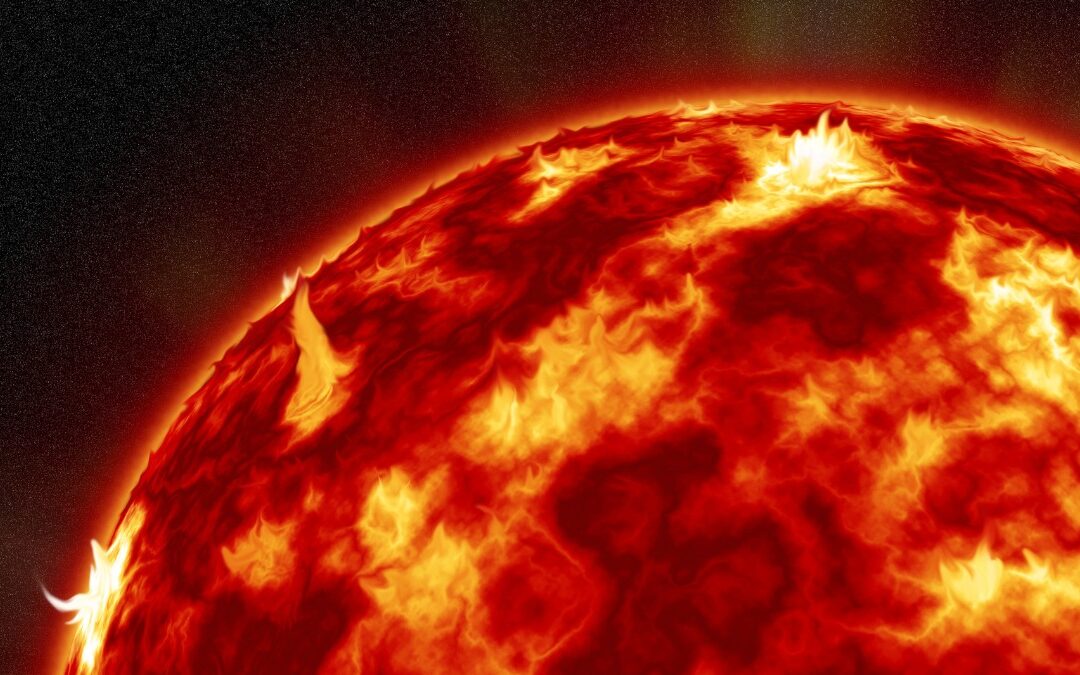
NASA and IBM have jointly developed a cutting-edge artificial intelligence model named Surya, designed to predict solar flares with remarkable precision. This breakthrough marks a significant advancement in space weather forecasting, offering a 16% improvement over previous models. Surya is trained on nine years of high-resolution solar data and can forecast solar flares up to two hours before they occur—an invaluable window for protecting satellites, power grids, and communication systems from the disruptive effects of solar storms.
The name “Surya,” derived from the Sanskrit word for “Sun,” reflects the model’s mission to decode the complex behavior of our star. Unlike conventional AI systems that rely heavily on labeled datasets, Surya uses a foundation model approach, learning from vast amounts of raw, unlabeled solar imagery. This enables it to detect subtle patterns and anomalies that traditional models might miss, making it a powerful tool for both scientific research and operational readiness.
How Surya Learns from the Sun’s Activity
Surya’s intelligence is built on data collected by NASA’s Solar Dynamics Observatory (SDO), which has been capturing multi-wavelength images of the Sun every 12 seconds for over a decade. These images include ultraviolet and extreme ultraviolet data from the Atmospheric Imaging Assembly (AIA), as well as magnetic field maps from the Helioseismic and Magnetic Imager (HMI). This rich dataset allows Surya to understand the Sun’s dynamic surface and anticipate its behavior.
The model uses a hybrid architecture that combines long–short vision transformers with spectral gating, enabling it to process solar images at their native 4096×4096 resolution. This design allows Surya to identify both fine-scale features and large-scale solar structures, making it capable of forecasting not only solar flares but also solar wind speeds and the emergence of active regions. Its ability to simulate future solar activity sets a new benchmark in heliophysics and space weather prediction.
Why Accurate Solar Flare Forecasting Matters
Solar flares and coronal mass ejections (CMEs) can have serious consequences for modern infrastructure. These space weather events can disrupt GPS signals, interfere with radio communications, damage satellites, and even trigger power grid failures. In aviation, solar storms pose radiation risks to crew and passengers, especially on polar routes. For astronauts and spacecraft, the stakes are even higher, as exposure to intense solar radiation can be life-threatening.
By providing early warnings, Surya enables operators to take preventive measures such as rerouting flights, powering down vulnerable systems, or placing satellites in safe mode. This proactive approach can save billions of dollars in potential damages and ensure the continuity of essential services. As humanity becomes increasingly dependent on space-based technology, tools like Surya are vital for maintaining resilience against solar threats.
Open-Source Access and Global Collaboration
One of the most promising aspects of Surya is its open-source availability. NASA and IBM have released the model on platforms like https://malaka555.sg-host.com/ and GitHub, inviting researchers, developers, and institutions worldwide to contribute, customize, and expand its capabilities. This democratization of space weather forecasting tools fosters innovation and accelerates scientific discovery.
Surya is part of a broader initiative to integrate AI into planetary and solar system exploration. It joins other foundation models developed by IBM, such as Prithvi, which focus on geospatial analysis and climate prediction. Together, these models represent a shift in how artificial intelligence is used—not just as a computational tool, but as a catalyst for understanding complex natural systems.
As solar activity intensifies with the approach of the Sun’s 11-year cycle peak, the need for reliable forecasting becomes more urgent. Surya’s success demonstrates how AI can bridge the gap between observation and prediction, offering humanity a powerful ally in the quest to understand and protect our place in the cosmos.